The firm introduces a fully integrated tech solution that redefines how financial professionals manage client relationships, portfolios, and compliance.


Miami, FL – September 4th, 2025 – Insigneo, a leading global wealth management firm, has officially launched Alia 2.0, a next-generation technology platform designed to streamline and modernize the way investment professionals manage their practices. This proprietary solution brings together important elements of the advisor workflow into one cohesive digital environment, empowering users with greater clarity, control, and efficiency.

Originally introduced in November of 2022 as a web-based financial services CRM for portfolio visibility and onboarding, Alia has since evolved into a strategic technology ecosystem that now powers core operations across Insigneo’s global network. The launch of Alia 2.0 marks a significant milestone in that evolution, delivering new capabilities and laying the foundation for future innovation.

Unlike legacy systems that force advisors to toggle between fragmented platforms, Alia 2.0 was built to eliminate the “swivel chair” by providing a unified advisor experience. Through single sign-on access, advisors can now manage client onboarding and servicing across custodians, compliance, and execution, from a centralized workspace. The platform integrates best-in-class technologies, including tools for real-time data validation, automated workflows, and configurable dashboards, curated and embedded to align with the evolving needs of today’s investment professionals.

“As the wealth management industry becomes more complex, the need for purposeful, integrated technology has never been greater,” said Javier Rivero, President and Chief Operating Officer at Insigneo. “With Alia 2.0, we’re delivering a powerful platform that supports financial professionals in their day-to-day, enhancing transparency, increasing speed, and strengthening the advisor-client relationship at every step.”

Multi-custody functionality is at the heart of the Alia 2.0 experience, offering advisors seamless visibility across accounts and custodians. Designed with scalability in mind, the platform will continue to evolve in the coming months with additional features focused on account opening, third-party integrations, and portfolio-level insights, ensuring Alia 2.0 remains a future-ready solution for a rapidly shifting industry.

“Alia 2.0 is a purpose-built platform that removes complexity and delivers precision,” said Vikas Saxena, Chief Technology Officer at Insigneo. “Supported by Salesforce and integrated with applications like Orion, Luma and InEx Trade, Alia creates a single workspace where advisors can open accounts, manage compliance (including KYC and AML), track SLAs, and deliver client-ready reports—all from one location. It’s not just a system; it’s an ecosystem designed to grow with the advisor.”

With the launch of Alia 2.0, Insigneo reaffirms its long-term commitment to investing in technology that empowers financial professionals. More than a platform, Alia 2.0 represents the firm’s belief that better tools lead to enhanced practice management and better outcomes for clients.

About Insigneo
Insigneo is a leading international wealth management firm providing services and technologies that empower investment professionals to successfully serve their clients globally. Insigneo leverages its customized solutions, client-first service, and custodial relationship with BNY Mellon’s Pershing to provide a fully integrated, best-in-class wealth platform. With over $27.4B* in supported customer assets, Insigneo empowers more than 300 investment professionals and 65 institutional firms serving over 32.000 clients.. For more information, visit www.insigneo.com

(*) as of Q2 2025

We are delighted to announce that Insigneo has successfully completed the acquisition of Riva Darno S.A.,  soon to be known as Insigneo Gestor International S.A., marking yet another significant milestone in our firm’s growth trajectory and reaffirming our dedication to continuity in the region.

Sebastian Ballester, former Director of Riva Darno S.A, will continue his association with Insigneo as an Investment Professional. Moreover, Sebastian will remain a shareholder of Insigneo within our advisor cohort with a permanent seat on the Partner Advisory Board in Uruguay. His ongoing focus on Insigneo’s success and strategic contributions will continue to shape the future direction, a testament to his belief in our vision and potential.

Assuming a new advisory responsibility to drive Insigneo’s growth in the Southern Cone, Sebastian will assist the M&A and Market Head teams in identifying growth opportunities within the region in a non-management capacity to ensure clarity and focus within the organization.

We are confident in his success and extend our best wishes to Sebastian in his new endeavors.


More about Insigneo


Over the past year, Insigneo has been taking steps to shore up its leadership team to help its expansion efforts. In May, the group hired Alfredo Maldonado to lead its business in New York and later recruited Carlos Mejia for the newly created role of head of M&A in September and  Michael Averett as chief revenue officer was also part of this initiative.

Insigneo also revealed it had added over 36 advisors to its international network in 2023, including several experienced advisors from Morgan Stanley as well as others from Merrill Lynch and Oppenheimer.

The firm’s growth push also saw it open four new US offices last year in Coral Gables, Fl., San Diego, Calif., San Antonio and Laredo, Texas, and one in Colombia in Cali. Insigneo also opened an office of supervisory jurisdiction (OSJ) in Houston, Texas, the group said.

These new locations are in addition to Insigneo’s existing US offices in Miami Fl., New York, N.Y., San José (Puerto Rico) and in Latin America in Montevideo, Buenos Aires, Santiago.

The Miami-based firm manages more than $24bn in assets and supports more than 440 advisors who cater to international clients, with a particular focus on wealthy investors in Latin America.

During the upcoming electoral frenzy, it is essential for investors to adopt a systematic, unbiased strategy towards US politics and policy, which is the goal of this section.

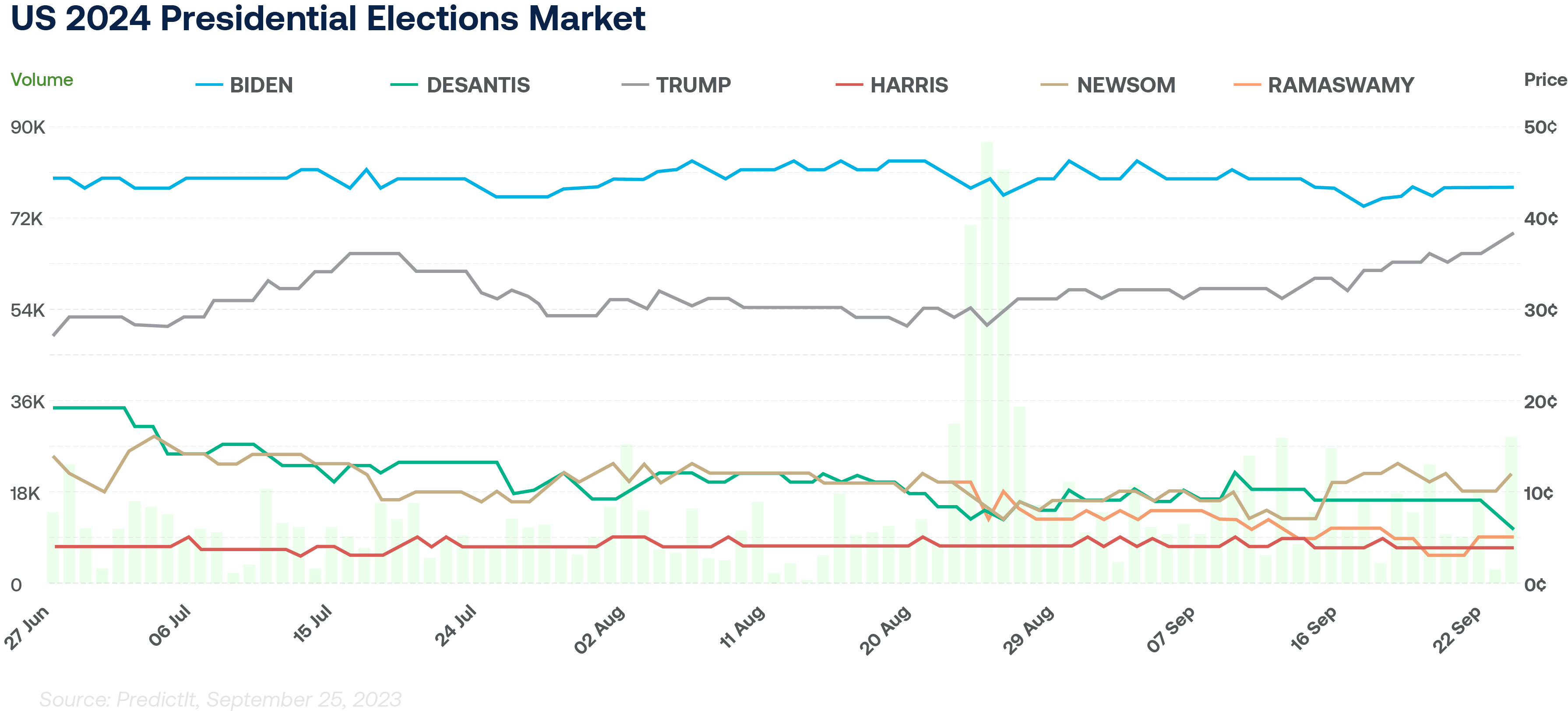
This chart Illustrates that the foremost candidates for the 2024 presidency – Biden and Trump – would both be in their second term and of advanced age, potentially resulting in a more assertive foreign policy. A candidate in their first term, such as someone following Trump’s path like Governor Ron DeSantis of Florida, would likely face constraints if financial market instabilities jeopardized their chances for re-election. However, as the chart indicates, the prospect of a candidate other than the two front-runners, like DeSantis, is dwindling. Consequently, the likelihood of having second-term presidents in 2024 is high.

Biden’s chances of re-election are somewhat uncertain compared to those of his party. This is not because he is less likely to secure a victory compared to another Democrat—historically, he has a better chance. Instead, uncertainties surrounding Biden’s age and health are factors that need consideration. Vice President Kamala Harris, the most probable successor to Biden, would remain a strong contender provided no economic downturn occurs. Harris’s perceived shortcomings are often exaggerated; she adequately represents the

party. A non-recessionary election with her as the candidate would likely center around societal topics, primarily women’s rights, such as abortion. Trump is expected to maintain support among Republicans unless he faces incarceration. Incarcerating him before the election would be challenging but feasible. Of all the cases open against him, the third round of indictments in Washington DC seems most likely to result in a conviction. Ultimately, political influence, rather than legal or ethical considerations, will shape the outcome of Trump’s case, as almost every post-election scenario under a Republican administration would likely lead to a pardon. While imprisonment does not legally hinder Trump, it would politically, in our view. In such a scenario, the Republican National Committee might opt for a younger, more appealing candidate to consolidate the party. DeSantis serves as a suitable alternative to Trump, with his alleged flaws, like those of Harris, often overstated. In our opinion, the Republicans’ chances of victory would increase behind a fresh face, like Vivek Ramaswamy, particularly if the US economy avoids a recession. If a combination of strict monetary policies and sluggish international growth causes a downturn in the labor market, then it makes Republicans the favorites. This holds even with Trump being the most likely nominee, and more so if another candidate represents the party. In sum, it is important to remember that the most likely determinant of who will win a contest between Biden and Trump is the answer to the following question: Is the US in a recession by the middle of 2024? If the answer is yes, Trump is the most likely victor. If the answer is no, then Biden should prevail.

Ahmed Riesgo – Insigneo’s Chief Investment Officer

Mr. Riesgo oversees all the company’s research and investment functions. This includes investment strategy, devising and implementing the firm’s global market views and asset allocation, communicating them to its clients and the public, and managing the firm’s model portfolios. In addition, he is the Chairman of the Insigneo Investment Committee.

While the prevailing sentiment among investors towards China is significantly bearish, mirroring the trends observed during 2015/16, apprehensions surrounding geopolitical conflicts, particularly Taiwan, have notably subsided. Presently, macroeconomic, and regulatory considerations are taking precedence over geopolitical risks, a shift we believe might be somewhat premature. The forthcoming elections in Taiwan could play a pivotal role in determining the trajectory of cross-strait geopolitical tensions. China possesses non-military alternatives that could have severe implications for the markets. Currently, investors should be wary of assuming that countries will overlook national security concerns or weaknesses in favor of economic progress and stability.

China, with its vast geographical core territories and highly-educated and rapidly-urbanizing population is as a formidable global power. Just for comparison, the United States produced six hundred thousand PhDs in STEM fields last year. China produced four million. However, its natural constraints, including deserts, mountains, and distant islands, affect its control and access to the sea. Historical and current tensions with neighboring islands and nations have remained, especially with Taiwan, a potential launchpad for attacks on China’s critical supply lines and ports. The inherent threat that Taiwan poses to China, and vice versa, remains, regardless of the peaceful intentions of their leaders. Contemporary events, such as Russia’s invasion of Ukraine, underline that geopolitical concerns continue to shape nations’ actions, despite advancements in globalization and democracy. Economic prosperity and integration do not necessarily overshadow- ow national security objectives. The persistence of conventional warfare amongst affluent nations demonstrates that security interests often surpass economic ones.

“The forthcoming elections in Taiwan could play a pivotal role in determining the trajectory of cross-strait geopolitical tensions.”

That means that the likelihood of China’s Xi regime engaging in preemptive wars, risking economic and societal stability, remains uncertain. The domestic perception of national capabilities might concurrently underestimate the opposition from other nations. Strategic failures in deterrence have been highlighted by events like the Ukraine war and have implications for China, where the risks of erratic or aggressive national policies are elevated under Xi Jinping’s consolidated rule. Currently, China’s focus is on addressing domestic economic challenges, technological advancement, and preparing for potential conflicts, emphasizing a quest for self-sufficiency, and acknowledging vulnerability to external influences.

The challenges facing China in a potential invasion of Taiwan are considerably greater compared to Russia’s invasion of Ukraine. Russia serves as a cautionary example, emphasizing restraint against engaging in direct conflicts with the West. Despite China’s untested military capabilities, the efficacy of the US’s strategic deterrence, particularly in minor or unconventional actions aimed at undermining Taiwan’s resolve, remains questionable. China can employ a variety of non-military strategies to weaken Taiwan’s economy and will. Meanwhile, the consensus within the US political system on countering China’s influence and supporting Taiwan introduces additional complexities. The outcome of Taiwan’s 2024 Election will significantly influence cross-strait relations, with different parties representing varied prospects for dialogue and strategic détente. A change in political power in Taiwan could alter Beijing’s approach, favoring gradual integration over military conflict, especially given the strategic significance of Taiwan’s prized technological assets – its high-end semiconductor foundries.

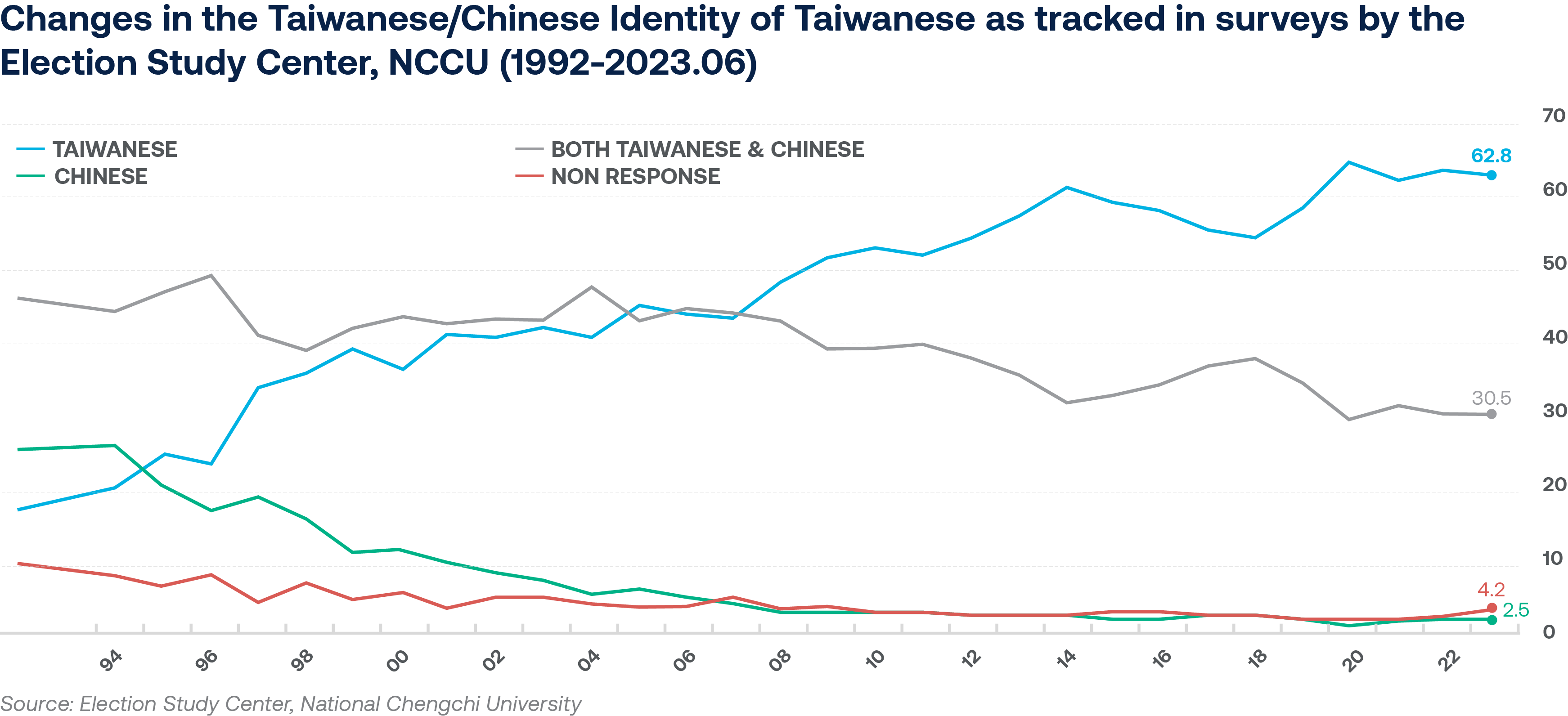
However, even if there is a change in political power in Taiwan, the potential for conflict persists eventually. The distinct Taiwanese identity and their unwillingness to compromise on freedom and security pose challenges to integration. This chart indicates that approximately 63% of the population identifies exclusively as Taiwanese. This shift in identity, coupled with China’s aggressive policies under Xi Jinping, has distanced the democratic Taiwanese further from the Mainland, limiting the concessions that could be made during negotiations.

In anticipation of the upcoming elections, investors should brace for escalating policy uncertainties in both China and Taiwan. The election results will be instrumental in dictating whether tensions escalate or

de-escalate in the short term. While a full-scale invasion by China is not imminent, in our view, a reelection of the Democratic Progressive Party could lead to intensified economic, cyber, and diplomatic pressure on Taiwan. Failing this, Beijing might explore other tactics, including asserting maritime authority, imposing embargoes, or employing hybrid military strategies against Taiwan’s territories. All these actions would increase the geopolitical risk premium on East Asian risk assets.

Ahmed Riesgo – Insigneo’s Chief Investment Officer

Mr. Riesgo oversees all the company’s research and investment functions. This includes investment strategy, devising and implementing the firm’s global market views and asset allocation, communicating them to its clients and the public, and managing the firm’s model portfolios. In addition, he is the Chairman of the Insigneo Investment Committee.

こんにちは (Kon’nichiwa), Japan!

There are mounting indications that the Japanese economy is performing exceptionally and entering a virtuous cycle of income gains and increased consumer consumption. In addition, numerous indicators suggest potential upward shifts in Japanese inflation. In Japan, a country battling deflation for thirty years, this is welcome news. This is likely to enhance interest-rate differentials, benefiting the Japanese Yen, especially given the currency’s notable undervaluation. On a Purchasing Power Parity basis, the Yen is undervalued by 40%. The key takeaway for investors is to prioritize the Japanese Yen while concurrently minimizing exposure to Japanese government bonds. A suitable comparison can be drawn to the dynamics of the US Dollar and Treasuries in 2022, where it proved advantageous to invest in the US Dollar and divest from Treasuries. A parallel situation appears to be unfolding in Japan.

The key rationale behind this viewpoint is the substantial evidence suggesting upwardly revised economic surprises in the country. While the Bank of Japan has begun to unwind its Yield Curve Control program, this means that we can expect a more hawkish central bank in the near future. Japan’s Q1 and Q2 2023 real GDP growth figures of 0.9% QoQ and 6.0% QoQ, respectively, reveal a nation that is experiencing high and accelerating growth. Particularly, since the trend or potential growth in the island nation is only approximately 0.5% by the central bank’s own estimates. The consumption activity index has returned to levels seen before the pandemic, despite a generally low propensity to consume in Japan. The country was among the last to lift travel restrictions, leading to cautious spending amid widespread economic uncertainty. As normalcy gradually resumes, accumulated demand is expected to bolster spending in Japan.

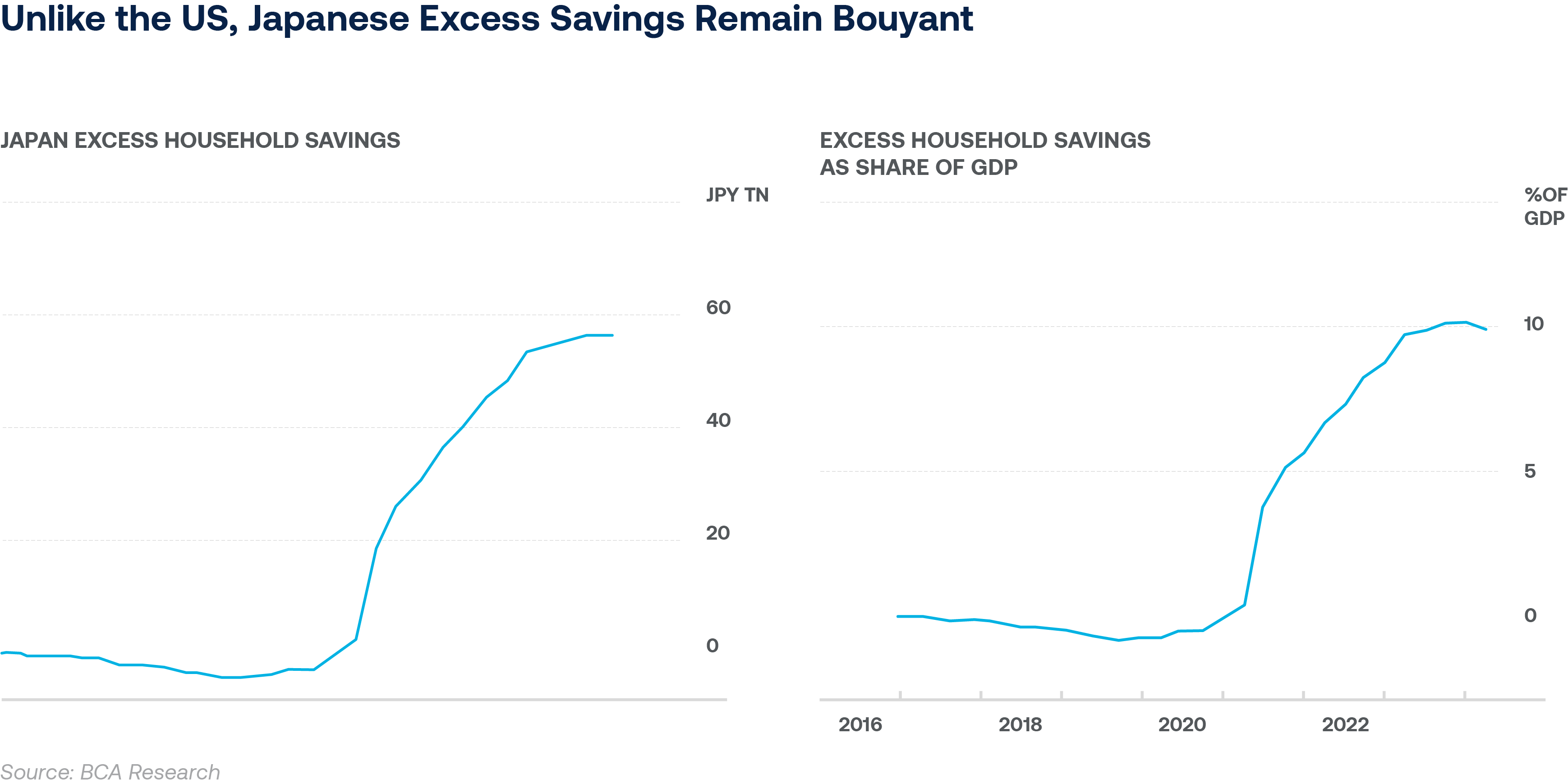
Governmental aid has also allowed households to accumulate significant savings. This graph indicates that excess savings in Japan presently constitute 10% of GDP, maintaining a robust position compared to the sharp decline in the US that we discussed earlier. The Japanese still have a lot of extra money in their pockets. Theoretically, this could enable Japanese consumers to drive economic growth at trend levels solely based on these excess savings for the upcoming five years, not including any income. Additionally, considerations are being made to extend support measures, such as fuel and gas subsidies. Signs of growing consumer confidence are becoming evident across various sectors including employment prospects, income growth, and purchasing intent for durable goods. In our view, only an exogenous shock could derail the Japanese economy at this moment. Some other risks include a deceleration in the pace of foreign machinery orders and machine tool orders. In addition, after a substantial surge over the previous two years, Japanese exports are experiencing a waning despite the currency’s depreciation. However, given the substantial war chest of excess reserves amounting to 10% of GDP, Japanese consumers should be able to weather any storm quite well.

Ahmed Riesgo – Insigneo’s Chief Investment Officer

Mr. Riesgo oversees all the company’s research and investment functions. This includes investment strategy, devising and implementing the firm’s global market views and asset allocation, communicating them to its clients and the public, and managing the firm’s model portfolios. In addition, he is the Chairman of the Insigneo Investment Committee.

This site uses cookies to offer you a better browsing experience. Read how we use cookies and view our privacy policy.