
During the upcoming electoral frenzy, it is essential for investors to adopt a systematic, unbiased strategy towards US politics and policy, which is the goal of this section. The chart Illustrates that the foremost candidates for the 2024 presidency – Biden and Trump – would both be in their second term and of advanced age, potentially resulting in a more assertive foreign policy...
Insight Type: Big thinking
While the prevailing sentiment among investors towards China is significantly bearish, mirroring the trends observed during 2015/16, apprehensions surrounding geopolitical conflicts, particularly Taiwan, have notably subsided. Presently, macroeconomic, and regulatory considerations are taking precedence over geopolitical risks, a shift we believe might be somewhat premature. The forthcoming elections in Taiwan could play a pivotal role in determining the trajectory of cross-strait geopolitical tensions. China possesses non-military alternatives...
While the prevailing sentiment among investors towards China is significantly bearish, mirroring the trends observed during 2015/16, apprehensions surrounding geopolitical conflicts, particularly Taiwan, have notably subsided. Presently, macroeconomic, and regulatory considerations are taking precedence over geopolitical risks, a shift we believe might be somewhat premature. The forthcoming elections in Taiwan could play a pivotal role in determining the trajectory of cross-strait geopolitical tensions. China possesses non-military alternatives that could have severe implications for the markets. Currently, investors should be wary of assuming that countries will overlook national security concerns or weaknesses in favor of economic progress and stability.
China, with its vast geographical core territories and highly-educated and rapidly-urbanizing population is as a formidable global power. Just for comparison, the United States produced six hundred thousand PhDs in STEM fields last year. China produced four million. However, its natural constraints, including deserts, mountains, and distant islands, affect its control and access to the sea. Historical and current tensions with neighboring islands and nations have remained, especially with Taiwan, a potential launchpad for attacks on China’s critical supply lines and ports. The inherent threat that Taiwan poses to China, and vice versa, remains, regardless of the peaceful intentions of their leaders. Contemporary events, such as Russia’s invasion of Ukraine, underline that geopolitical concerns continue to shape nations’ actions, despite advancements in globalization and democracy. Economic prosperity and integration do not necessarily overshadow- ow national security objectives. The persistence of conventional warfare amongst affluent nations demonstrates that security interests often surpass economic ones.
“The forthcoming elections in Taiwan could play a pivotal role in determining the trajectory of cross-strait geopolitical tensions.”
That means that the likelihood of China’s Xi regime engaging in preemptive wars, risking economic and societal stability, remains uncertain. The domestic perception of national capabilities might concurrently underestimate the opposition from other nations. Strategic failures in deterrence have been highlighted by events like the Ukraine war and have implications for China, where the risks of erratic or aggressive national policies are elevated under Xi Jinping’s consolidated rule. Currently, China’s focus is on addressing domestic economic challenges, technological advancement, and preparing for potential conflicts, emphasizing a quest for self-sufficiency, and acknowledging vulnerability to external influences.
The challenges facing China in a potential invasion of Taiwan are considerably greater compared to Russia’s invasion of Ukraine. Russia serves as a cautionary example, emphasizing restraint against engaging in direct conflicts with the West. Despite China’s untested military capabilities, the efficacy of the US’s strategic deterrence, particularly in minor or unconventional actions aimed at undermining Taiwan’s resolve, remains questionable. China can employ a variety of non-military strategies to weaken Taiwan’s economy and will. Meanwhile, the consensus within the US political system on countering China’s influence and supporting Taiwan introduces additional complexities. The outcome of Taiwan’s 2024 Election will significantly influence cross-strait relations, with different parties representing varied prospects for dialogue and strategic détente. A change in political power in Taiwan could alter Beijing’s approach, favoring gradual integration over military conflict, especially given the strategic significance of Taiwan’s prized technological assets – its high-end semiconductor foundries.
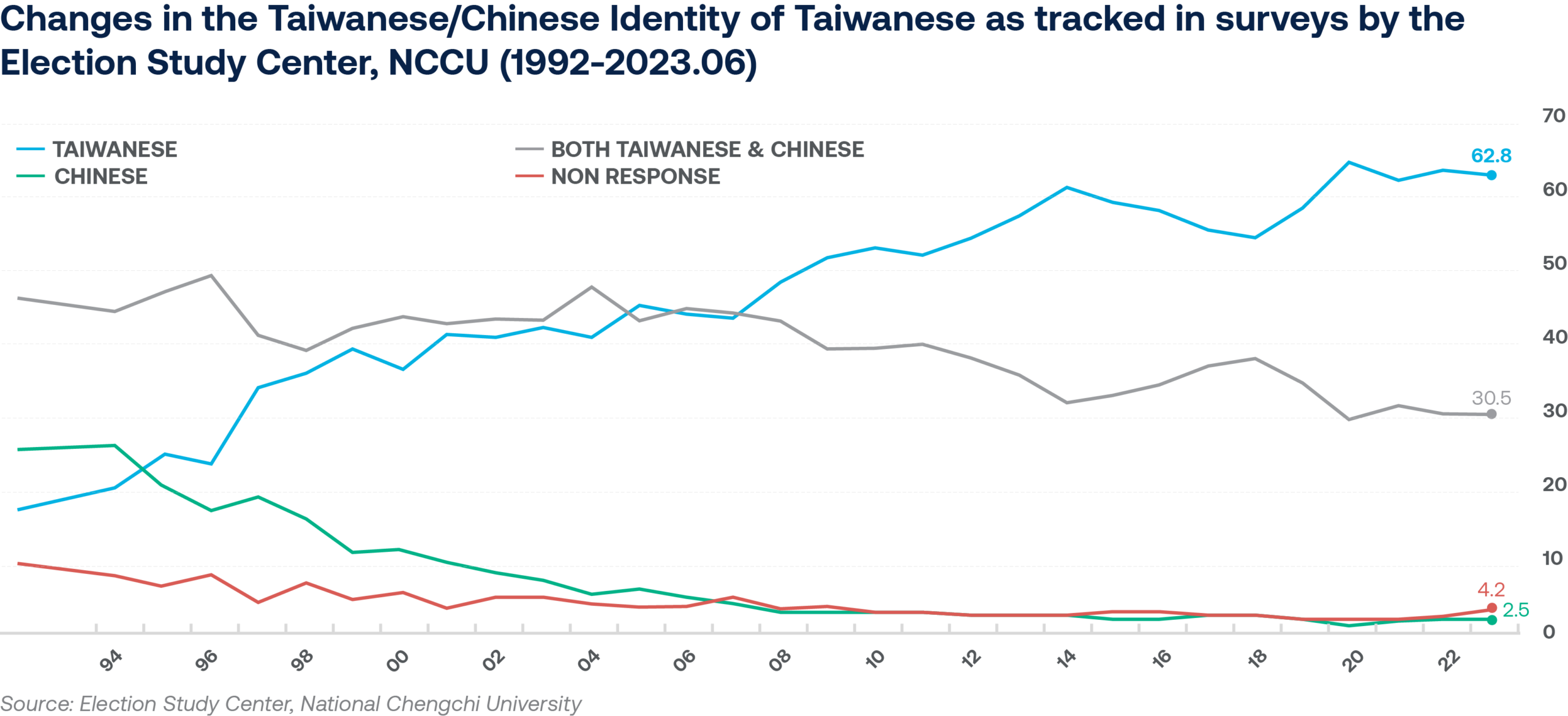
However, even if there is a change in political power in Taiwan, the potential for conflict persists eventually. The distinct Taiwanese identity and their unwillingness to compromise on freedom and security pose challenges to integration. This chart indicates that approximately 63% of the population identifies exclusively as Taiwanese. This shift in identity, coupled with China’s aggressive policies under Xi Jinping, has distanced the democratic Taiwanese further from the Mainland, limiting the concessions that could be made during negotiations.
In anticipation of the upcoming elections, investors should brace for escalating policy uncertainties in both China and Taiwan. The election results will be instrumental in dictating whether tensions escalate or
de-escalate in the short term. While a full-scale invasion by China is not imminent, in our view, a reelection of the Democratic Progressive Party could lead to intensified economic, cyber, and diplomatic pressure on Taiwan. Failing this, Beijing might explore other tactics, including asserting maritime authority, imposing embargoes, or employing hybrid military strategies against Taiwan’s territories. All these actions would increase the geopolitical risk premium on East Asian risk assets.
There are mounting indications that the Japanese economy is performing exceptionally and entering a virtuous cycle of income gains and increased consumer consumption. In addition, numerous indicators suggest potential upward shifts in Japanese inflation. In Japan, a country battling deflation for thirty years, this is welcome news. This is likely to enhance interest-rate differentials, benefiting the Japanese Yen, especially given the currency’s notable undervaluation...
The mega-cap technology stocks that have led the current stock rally will undoubtedly be major beneficiaries of the AI trend. However, the benefits of this new technology will expand well beyond these companies.
During our last quarterly call, we said that dominant players in the AI industry like Microsoft, Alphabet, and Nvidia would be big beneficiaries of the development of this new technology. Boy, are we glad we said that! Since then, these stocks have led the markets higher...
After the pandemic, the term “nearshoring” became popular in the media. Given the potential implications of this phenomenon on the Latin American region, it is worth exploring it in more detail. Forbes describes nearshoring as a “tactic that allows companies to move their operations to the closest country with a qualified workforce and reduced cost of living without the time difference.” (Maritza Diaz, Forbes, 2021). In essence, nearshoring is a form of offshoring, but with different goals in mind.
Offshoring became popular in the 1980’s as many companies...
Latin America and Lithium are intertwined in a nascent relationship. It is estimated that out of the 89 million tons of lithium reserves in the world, as much as 60% of these are found in Latin America. The majority of these deposits, over 55% of total global deposits, lie in a region known as the “Lithium Triangle”, comprised of Chile, Argentina, and Bolivia. As we can see on the chart, approximately 24% of lithium resources lie in Bolivia, 22% in Argentina...
One of the most repeated lessons from this history is that scarcity leads to innovation. Incidentally, the corollary to this principle is that hubris leads to downfall – just ask Putin how his ill-advised and ill-planned invasion of Ukraine is going. Another important teaching is that political and macroeconomic systems are very complex. And people tend to focus only on the first-order effects of policy and decision-making. But it is usually the second, and even third, order effects that are most important and least accounted for, the ones least priced-in by markets.
It is a well-known fact that the pandemic caused births globally to collapse and that they remain below levels necessary to stabilize population growth. We also know that aging populations place a major strain on pension and health care systems as fewer workers have to support more consumers and retirees.
This graph demonstrates that after rising steadily since the 1980s, the global support ratio, or the ratio of workers to consumers, peaked a few years ago and is projected to collapse to levels last seen during the 1970s.
As I mentioned before, we believe globalization peaked around 2008 and has been slowly but steadily declining ever since the Global Financial Crisis. Moreover, the two most recent global events – the pandemic and the Russian invasion of Ukraine – have only accelerated that trend by exacerbating policymakers’ reliability concerns when dealing with less-than-friendly state actors. Whether they manifest themselves as US shortages of masks made in China during the pandemic or Russia holding its oil and natural gas exports over Europe’s head as it invades European territory, these issues are forcing Western...
Even if it has been around longer than what investors believe, sustainable and ESG investing has increasingly won over the center stage for investors across the world, with a large number of asset classes becoming more and more available for those investors who aside from getting a return on investment, are looking to generate an impact beyond financial gains. Nonetheless, investors are increasingly concerned about the quality of such ‘sustain- able’ or ‘green’ investments, with terms like ‘green-washing’ or ‘social-washing’ becoming more common.
El Salvador recently made history after being the first country in the world to implement bitcoin as a legal tender; however, the situation doesn’t seem as flattering as initially thought by president Bukele. It is relevant to remember the initial motives that drove Bukele towards the implementation of bitcoin as a legal tender: firstly, El Salvador’s great dependency on remittances, accounting for almost one-quarter of the country’s GDP. Secondly, this project is Bukele’s attempt to bring Salvadoreans closer to financial inclusion, given that most of the population doesn’t have a bank account.